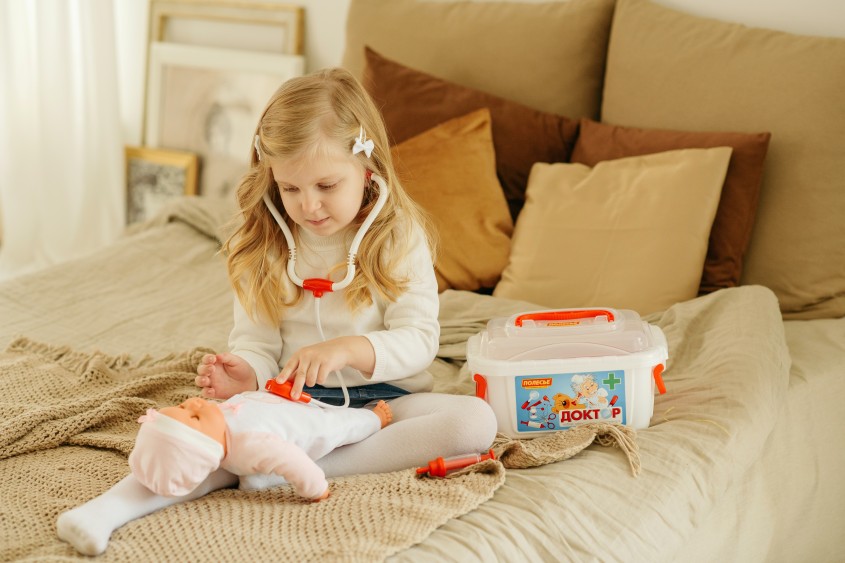
Kid playing with Doctors kit

Help Young Children Play on their Own

Peace at Home October 2020 | JoAnn Robinson, Cora D'Alessandro

Many parents are asking, “How am I supposed to homeschool my child AND work from home? I am not a teacher!” This can feel overwhelming and impossible. You are not alone.

It is important to start small and plan no more than one or two activities for your child per day. Use items that you can easily find around the house- don’t reinvent the wheel. Here are some ways to set you and your child up for success:

  • Organize your space to promote independent play. Remove hazards, and offer a variety of “open-ended” materials that your child can use independently. Cardboard boxes keep children of all ages engaged for long periods of time because they can be used in so many different ways. Use couch cushions for climbing or to build a fort. Offer buckets, Tupperware containers, or reusable shopping bags for filling up/dumping or transporting objects. You may be surprised at how simple activities like this keep your child occupied while promoting critical thinking and problem-solving skills.
  • Give your child an assignment or a task to accomplish. For example, ask them to go into the backyard and collect 5 acorns, 3 pebbles, and 1 twig. For toddlers, keep the tasks very simple, such as filling up a bag with stuffed animals. Encourage them to check in with you when they are finished. Together you can count how many are in the bag. Praise them for completing the assignment with high 5’s. Not only does this promote your child’s independence, but it also brings them back to connect with you – an important motivating factor!
  • Set up a “workspace” for your child next to where you are working. Use materials such as legos, train sets, coloring/activity books, or even sorting socks. If you set it up as a “job” for your child, they will feel like their work is important, just like yours! To encourage this independence for longer chunks of time, use a timer. Try 10 minutes of independent “work” to start and adjust as needed.
  • Be sure to praise your child when they complete a task or are behaving the way you would like them to behave. You will get MORE of the behavior that you praise. For example, “You are being so helpful by matching those socks.” or “You worked so hard to collect all of those trucks!” Talking about each truck is great to promote language development, too.
  • Finally, make it a priority! Being in nature for a hike or playing outdoors reduces stress, and the exposure to sunlight and exercise helps to improve sleep therefore strengthening our immune systems.  Find 20 minutes every day, even during a light rain shower, to be outside with your children.  Stomp in the puddles together.  Sing a song while you walk.  Make some positive memories in the stressful time.

This is a challenging period for everyone, so be kind to yourself and to your child. The more practice your child gets being independent, the easier this will become.

Looking for More Support?

Questions? Email us at solutions@peaceathomeparenting.com

And now for the shameless plug…
Don’t have a Peace at Home Parenting Portal? Let’s fix that. Ask your company, school, or favorite neighborhood group to join us. We’ve got CorporateK-12 School, and Family Service programs that bring calm to the chaos—no yoga mat required. Click here to join as an individual or family.
TOPICS

Related Posts

Peace at Home

When Screen Time Becomes the Fight: What to

School starts in a few weeks, and if your house already sounds like this, you are not imagining that it has gotten worse. “Five more minutes” turns into fifteen...

Peace at HomeAugust 17 , 2026
Peace at Home

How Can I Get My Child to Listen

Quick Summary: If your child won't listen without yelling, it's often a connection problem, not a behavior problem. Try "collecting" your child before giving di...

Peace at HomeAugust 11 , 2026
Peace at Home

New Research on Screen Time and Learning: What

Quick Summary: Two new studies link higher screen time to weaker academic performance, working memory, and well-being in kids. Screens alone don't determine a c...

Peace at HomeAugust 04 , 2026
Peace at Home

The Virtual Director: Why Gaming Makes Kids Resist

Quick Summary: Hours spent as the "director" of a virtual world flip the natural hierarchy kids need at home. When you ask them to step down and follow your lea...

Peace at HomeJuly 21 , 2026
Peace at Home

Digital Anesthesia: Why Screens Prevent Growth in Kids

Quick Summary: Screens act as digital anesthesia, numbing loneliness, boredom, or rejection the moment a child feels it. But kids only build emotional resilienc...

Peace at HomeJuly 21 , 2026
Peace at Home

The Thinking Shortcut: Protecting Your Child’s Mind in

Quick Summary: When AI hands kids the final answer instantly, it skips the mental struggle that builds critical thinking, leaving them consumers of thoughts rat...

Peace at HomeJuly 20 , 2026

Join our mailing lists for more parenting tips

pakde4d

togel online

pakde4d

Apk Dominoqq

Game Digital

Lotterly HK